

News
Veranstaltungsbericht: Workshop "Regulating Work in the Platform Economy: Paths, Strategies, and Challenges"
On 20 March 2026, the international academic workshop “Regulating Work in the Platform Economy: Paths, Strategies, and Challenges” was held in Duisburg. The workshop was organised within the framework of the Issue Network “Platforms – Work – Regulation” of the German Institute for Interdisciplinary Social Policy Research (DIFIS) by Fabian Beckmann (University of Duisburg-Essen) and Fabian Hoose (Ruhr University Bochum).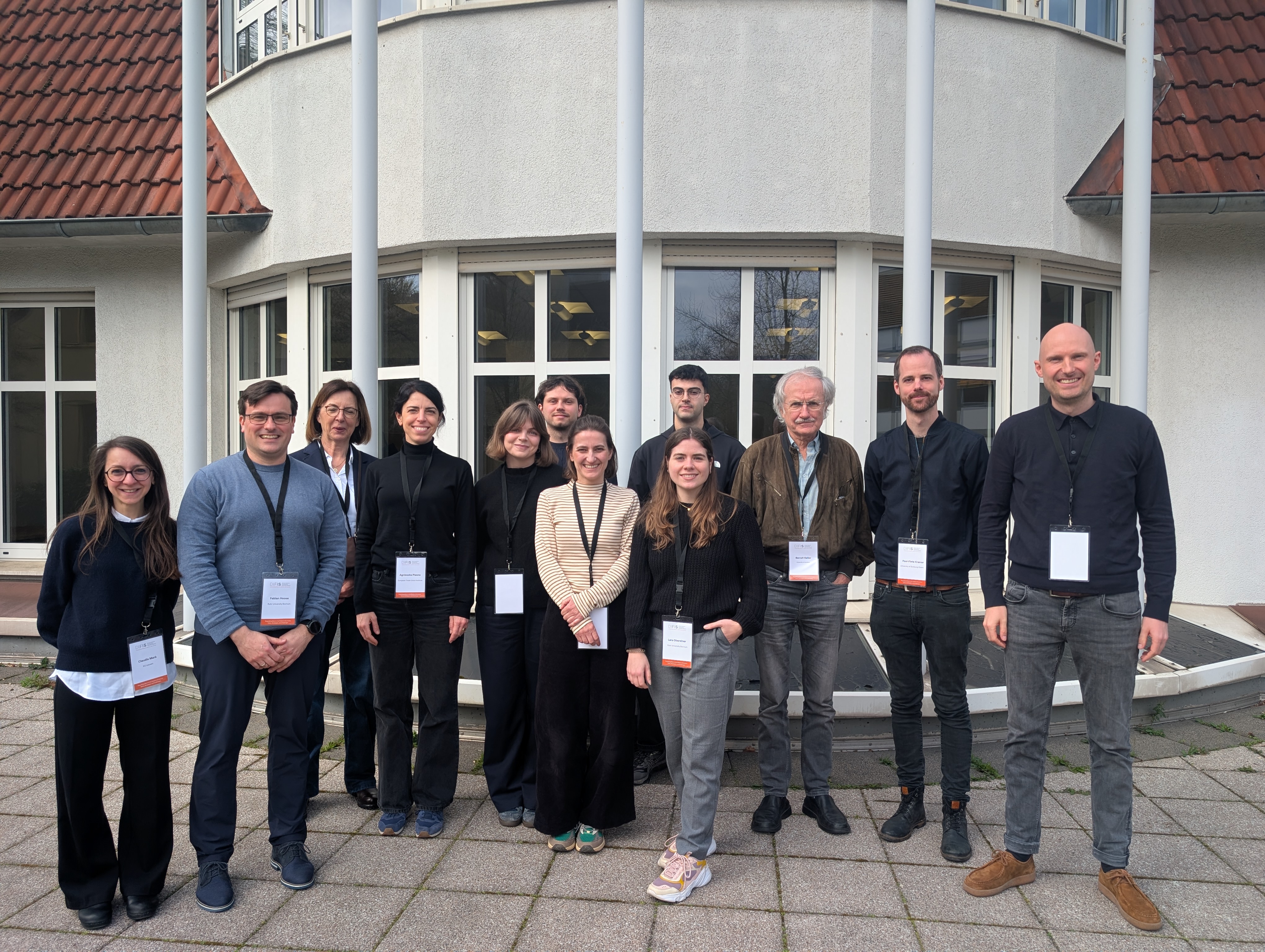
A group photo of the workshop participants in Duisburg
Against the backdrop of the disruptive effects of platform work on established institutions of labour regulation and social protection, the workshop brought together current research contributions on the regulation of platform work. These contributions are of particular relevance and timeliness in light of the EU Platform Work Directive adopted in 2024, which is currently undergoing national implementation.
In their introductory remarks, Fabian Beckmann (IAQ, University of Duisburg-Essen) and Fabian Hoose (Centre of Cooperation RUB/IGM, Ruhr University Bochum) discussed the causes and consequences of the lack of institutionalisation of work in the platform economy, while also pointing to increasing political efforts to close regulatory gaps. The EU Platform Work Directive represents the most far-reaching initiative to date; however, its success will depend largely on national implementation and enforcement strategies across Member States. While a growing body of academic literature addresses the dynamic development of the platform economy and its regulation, a key challenge remains the comprehensive representation of the diversity of institutional regulatory settings, platform labour models, and individual employment situations within platform work.
Agnieszka Piasna (European Trade Union Institute, Brussels) then addressed the role of platform companies in social dialogue at EU-level. Drawing on an analysis of consultations involving social partners and other stakeholders during the negotiations of the EU Platform Work Directive, she traced the key arguments advanced by different actors. While platform companies themselves denied their role as employers and promoted a narrative of “platform exceptionalism”, established European employers’ organisations adopted more heterogeneous positions, in some cases contradicting this narrative – partly because platform business models have tangible effects on the “conventional” economy and firms operating within it. Against this background, the author discussed the prospects and challenges of integrating platform companies into institutionalised forms of social dialogue and, drawing on her own study of collective mobilisation among platform workers in 14 European countries, emphasised the potential for collective representation in the platform economy.
Claudia Marà (KU Leuven) focused on platforms in the field of domestic services. Her contribution examined how platforms in this sector are embedded within institutional frameworks across different countries. By comparing Belgium and France – two countries characterised by extensive regulation of domestic work – her analysis demonstrated that platforms are not only characterised by varying functional models but also integrate into regulatory settings in distinct ways. While platforms in these contexts do not necessarily circumvent existing regulations, challenges such as low pay and precarious working conditions persist for platform workers. This raises the question of whether the formalisation of domestic work – also driven by platformisation – is sufficient to improve working and employment conditions in this sector.
In addition to domestic services, the presentation by Sabrina Glanz and Lara Obereiner (both Centre of Cooperation RUB/IGM, Ruhr University Bochum) examined IT freelancing and content creation. Their contribution placed particular emphasis on gender inequalities and practices of social protection within these segments of the platform economy. Based on qualitative interviews with solo self-employed workers, the authors demonstrated that platform is characterised by highly segmented work logics, in which gender differences are reflected in motivations, self-conceptions, and strategies of social protection. While structural devaluation, low income, and correspondingly weak social protection dominate in domestic services, IT freelancing is characterised by higher income levels and more individualised protection strategies. Content creation emerges as an ambivalent field situated between autonomy and precarity, in which gender-specific risks related to visibility and recognition play a central role. Overall, the contribution highlighted how gender inequalities are reproduced through the specific logics of platform work. The authors therefore argued for more sector- and gender-sensitive regulatory approaches and pointed to gaps in current regulatory efforts.
In the subsequent presentation, Johanne Stenseth Huseby (Fafo, Oslo) focused on the Norwegian platform economy. Based on a study mapping digital labour platforms in Norway, three segments of platform work were identified: ride-hailing and delivery services, domestic services, and knowledge-intensive services. These segments differ significantly in terms of platform functions, work organisation, and resulting working conditions. The author illustrated how these segments vary with regard to external control and autonomy, as well as predictable versus unpredictable flexibility. In particular, workers in ride-hailing and delivery services face high levels of external control and unpredictable flexibility, for example in relation to working hours and the availability of gigs. In response, recent regulatory efforts in Norway have focused primarily on this more precarious segment, including a reform of the presumption of employment within the Norwegian Working Environment Act, specifically addressing regulatory challenges in this field.
A joint paper developed with Carla Brega Baytelman (University of Amsterdam) was presented by Karin Schulze Buschoff (WSI, Hans Böckler Foundation, Düsseldorf). It addressed the extent to which the EU Platform Work Directive can contribute to improving social protection for platform workers. Based on a comparison between Germany and the Netherlands, the authors showed that while the reclassification of platform workers with regard to employment status is an important step, it is insufficient on its own to ensure comprehensive social protection. The specific employment patterns of platform work – particularly multiple jobholding, low and irregular incomes, and fragmented employment trajectories – interact with social insurance schemes that remain oriented towards standard employment relationships. Against this background, the authors argue that structural barriers to access persist across different welfare state regimes and that reforms of social protection systems themselves are required.
The concluding discussion centred on the expected effects of the EU Platform Work Directive. It became clear that, despite its contribution to clarifying employment status and labour law classification, the directive cannot address all challenges associated with platform work. Its focus on labour law leaves key social policy questions unresolved. While the need for reform concerning non-standard forms of employment and solo self-employment has long been discussed in academic research, political implementation has so far remained limited. Consequently, social policy challenges are likely to persist, particularly for those platform workers who will continue to be classified as self-employed following national implementation of the directive. This raises important questions for future social policy research, including the long-term implications of embedding platform work within hybrid and unstable employment arrangements for social protection and working conditions, and the extent to which existing institutional arrangements remain adequate in addressing these transformations.
zurück zur Übersicht