Publikationen
DIFIS-Impuls 2026/9: Policy Progress, Practical Gaps: Why Cultural Norms and Rigid Work Structures Limit Work–Life Balance in Spain
In recent decades, many European countries have expanded family policies to support gender equality and help parents combine work and caregiving. Spain is a prominent example. Although the country adopted reforms later than many of its European counterparts, it has introduced ambitious measures over the past decade, including extended parental leave and the promotion of flexible working arrangements. However, the everyday experiences of families suggest that policy expansion alone is not sufficient to achieve effective work–life balance. Research shows that inequalities in paid and unpaid work persist despite the expansion of work–family policies. Mothers continue to assume a larger share of care and household responsibilities and often experience employment penalties related to caregiving. This indicates that formal policy rights alone do not guarantee equal opportunities to combine work and family life. Policies operate within broader institutional and cultural frameworks that shape expectations around work and caregiving. Normative models such as that of the adult worker, workplace expectations linked to the ideal worker and social norms surrounding parenthood influence how parents understand work–life balance and how they make use of available policies. Beyond formal entitlements, social expectations and organisational cultures shape the constraints parents face and the strategies they develop to reconcile work and care.
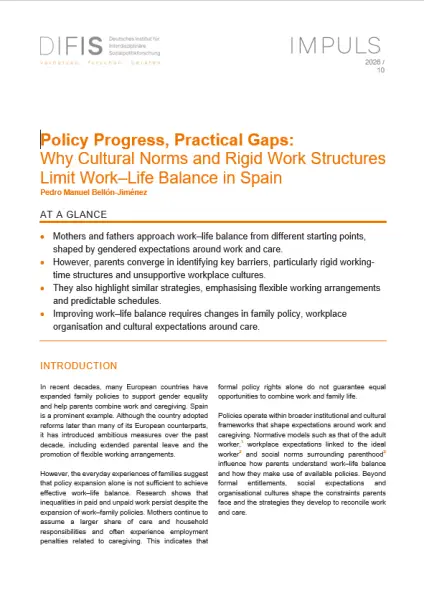
Pedro Manuel Bellón-Jiménez: DIFIS-Impuls 2026/9: Policy Progress, Practical Gaps: Why Cultural Norms and Rigid Work Structures Limit Work–Life Balance in Spain
DIFIS-Impuls 2026/9
 PDF